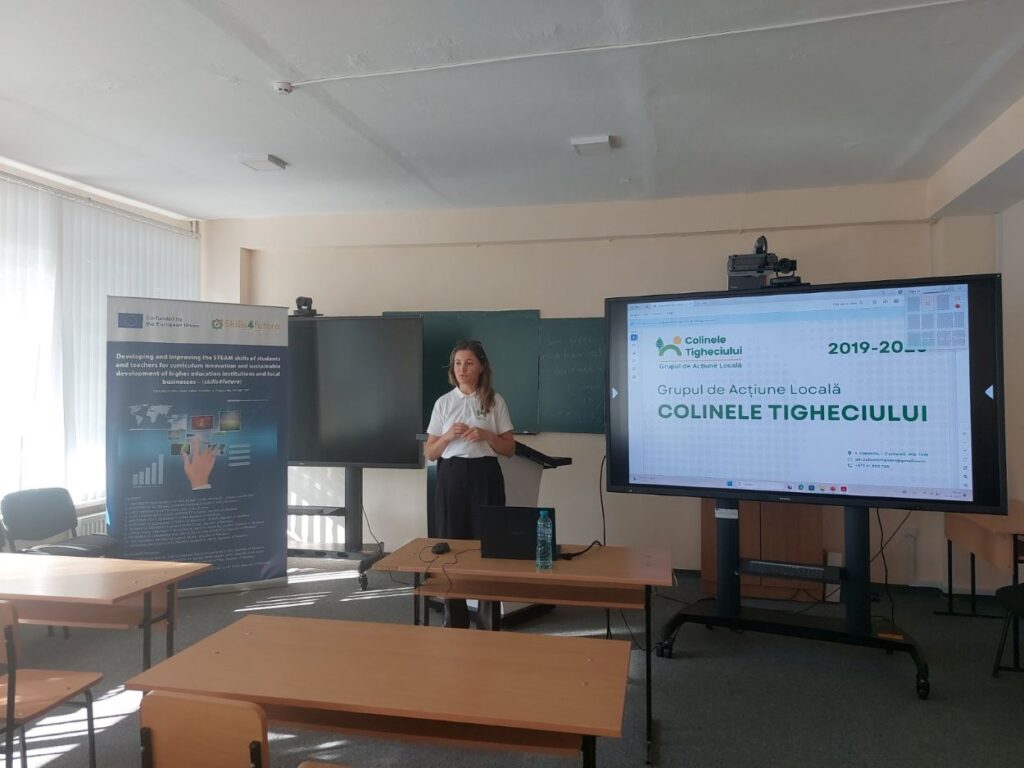
Between 15-22 September 2025, the STEAM Center within the Faculty of Economics, Engineering and Applied Sciences hosted a series of activities as part of the Digital and Green Week. This event was organized within the framework of the ERASMUS-EDU-CBHE project “Developing and improving STEAM competences of students and teachers for curricular innovation and sustainable development of higher education institutions and local businesses”. The event included two main sessions. The first took place on September 15 and addressed current trends in the field of Business 4.0, focusing on the impact of digitalization and automation in the agri-food and livestock sectors. Domnica Căpătina provided concrete examples from the activity of the “Bacii Sudului” Livestock Cluster, presenting:
– How smart technologies are applied in modern farms and slaughterhouses;
– Models for integrating value chains in the livestock sector;
– The need to develop digital skills among young specialists;
– Examples of partnerships between business and education to adapt to new economic realities The students asked questions about career opportunities in the cluster’s member companies, but also about the challenges encountered in the digitalization process.
The second guest was Ana Căpraru, owner of the La Cotihana Rest Area, who approached the development of the practical and sustainable perspective of the circular economy and the skills necessary for the transition to a green economy from the perspective of the managed business, came up with examples of sustainable practices implemented within her own company (waste reduction, use of local materials), the importance of training green skills among young entrepreneurs, the connection between ecological tourism, social responsibility and local development.
Students actively participated, asking questions about administrative obstacles for green businesses, sources of funding for such initiatives, and how they can integrate these principles into their academic or entrepreneurial projects.
The second session, held on September 22, aimed to explore the concept of applied intelligence for social purposes – that is, using knowledge, skills, and innovation to create sustainable solutions to community problems.
Rima Stăvilă, Director of the Colinele Tigheciului Local Action Group Association, gave an inspiring speech that covered the following topics:
– Successful models in rural entrepreneurship in Cantemir district;
– Key competencies needed in the field of social innovation: empathy, leadership, critical thinking, interdisciplinary collaboration;
– The role of Local Action Groups (LAGs) in supporting young entrepreneurs and innovative initiatives;
– Funding available through European, national funds and public-private partnerships.
Students were encouraged to reflect on their own social project ideas and had the opportunity to ask questions regarding: How can I integrate emotional intelligence into organizational leadership? How can I obtain support from financial institutions for initiatives with community impact?
In the second part, the session explored the practical dimension of digital innovation and entrepreneurship, especially in the context of youth development and involvement in digital transformation projects at the local level.
Lilia Garaz, Regional Director South Zone at Victoriabank, gave a dynamic presentation, in which she combined her extensive experience in the banking sector with concrete examples, relevant to the current context:
– Victoriabank’s experience in the digitalization of banking services;
– The role of banks in supporting innovative initiatives in digital entrepreneurship and their impact;
– Case studies from Victoriabank regarding involvement in educational, financial inclusion and digitalization projects;
– Career opportunities in the financial sector for young people interested in social transformations through innovation;
– How technology (online platforms, applications, e-commerce) can be used to develop sustainable businesses.
Participants were challenged to come up with ideas for digital start-ups that could contribute to the development of their community. Examples of already funded initiatives in the southern region of Moldova were presented, which provided a real and encouraging framework.
Both sessions made a valuable contribution to achieving the project objectives, providing students with direct access to practical expertise from the economic and associative environment. The event promoted an applied learning framework, focused on developing key competencies for the future: innovation, critical thinking, digitalization and social responsibility.
The events highlighted the importance of transversal competencies and opened a new perspective on how students can become agents of change in their own communities, regardless of their field of study. The need for human-centered thinking was highlighted as the foundation of real innovation.
Students from the following study programs actively participated in the events: Business and Administration, Accounting, Engineering and Management in the Food Industry, Engineering and Management in Mechanical Engineering, and Informatics.