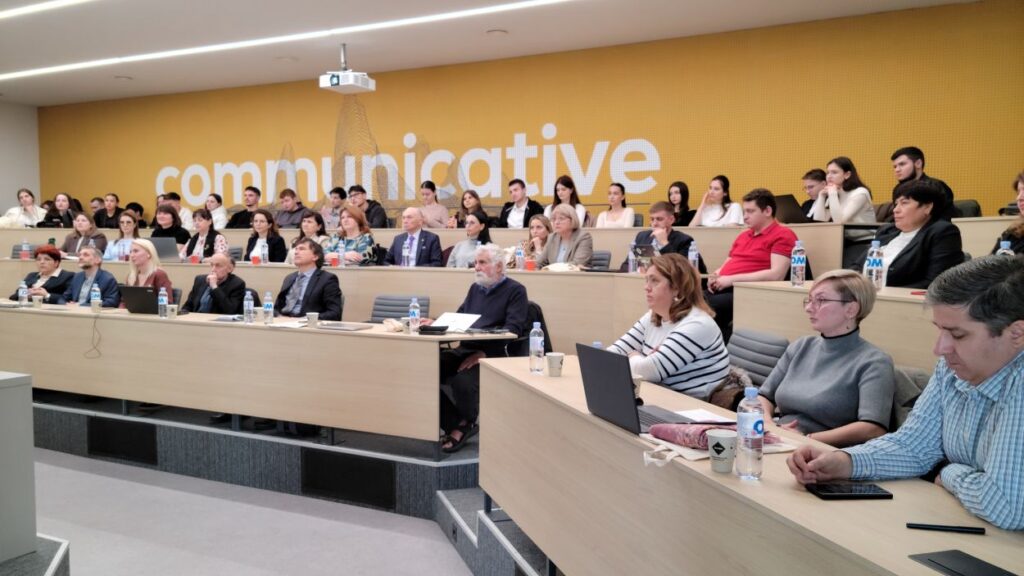
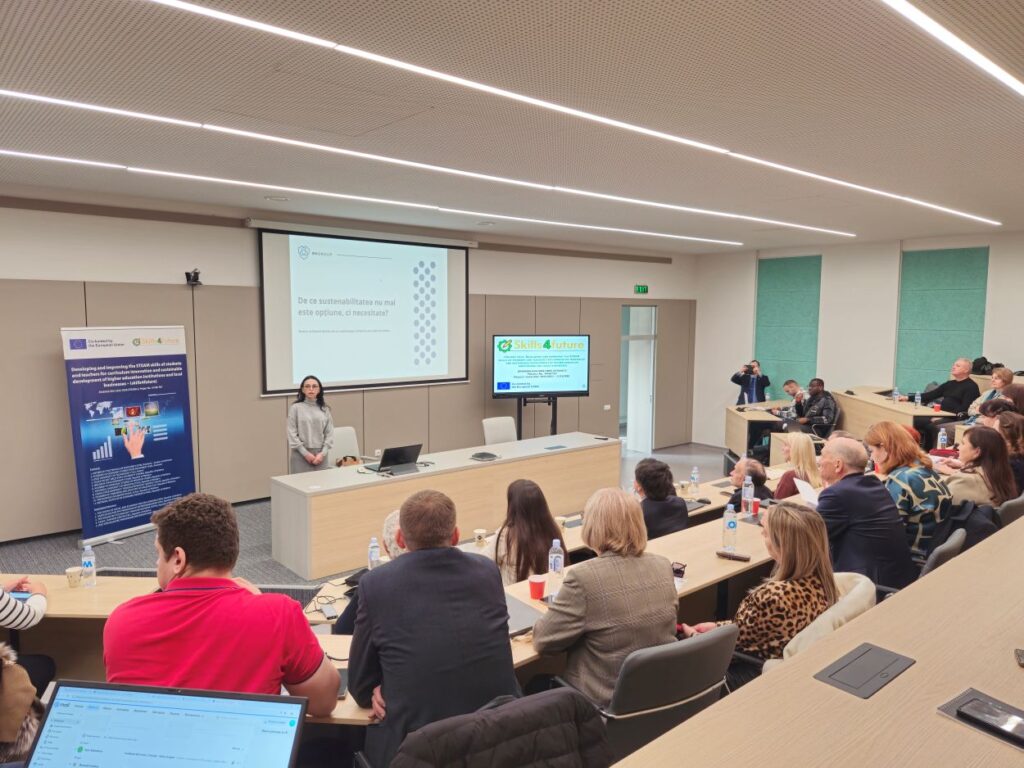
On October 30, 2025 – The Center for STEAM Skills and Innovation within the Department of Economics and Management, FIEB, UTM, organized the round table “STEAM Skills for Social Growth,” a multiplier event held as part of the Erasmus+ project “Skills4future – Developing and improving the STEAM skills of students and teachers for curriculum innovation and sustainable development of higher education institutions and local businesses.”
The event brought together representatives of academia, the business sector, and research institutions from the Republic of Moldova and abroad. The round table aimed to promote cooperation and the exchange of good practices on the development of STEAM (Science, Technology, Engineering, Arts, and Mathematics) skills – a fundamental pillar for innovation, competitiveness, and sustainable growth.
The event was attended by representatives of the project partners: POLITEHNICA University of Bucharest (Romania), Technical University of Lodz (Poland), Alecu Russo University of Bălți (Republic of Moldova), Moldova State University (USM), the Academy of Economic Studies of Moldova (ASEM), the Technical University of Moldova (UTM) – host of the event, Bogdan Petriceicu Hasdeu State University of Cahul, the Chamber of Commerce and Industry, Bălți branch, the National Institute for Economic Research (INCE), Cahul Business Incubator (ICAH)
The dean of the faculty, Mr. Ciloci Rafael, and the head of the Economics and Management Department, Ms. Rina Țurcan, emphasized the importance of STEAM skills training for sustainable social and economic growth. “Modern education must be anchored in innovation, interdisciplinarity, and collaboration. STEAM skills are no longer optional—they define professionals capable of transforming ideas into solutions for a sustainable world,” emphasized Associate Professor Rina Țurcan during the opening session.
The event agenda included thematic presentations and interactive debates, supported by representatives of the business community and partner universities:
“Sustainability practices within TEMELIA FACTORY” – Cristina Cujbă, director of TEMELIA FACTORY
“Responsible entrepreneurship: how we turn ideas into sustainable solutions” – Maria Bumbu, Brand Manager, BMGroup
“STEAM Skills for Social Growth” – Ludmila Botnari, Administrator, Autogrup Expres SRL
“Valorization of the wine heritage of the Republic of Moldova” – Dmitrii Caraman, Head of Sales Department, Key Account Moldova
“Managing the Risk Wildcard – Humans” – Dr. Marc H. Siegel, Fulbright Scholar and expert in organizational security and resilience, San Diego State University (USA).
University experts from European partners also shared best practices in developing STEAM skills:
- “Sustainability practices within TEMELIA FACTORY” – Cristina Cujbă, director of TEMELIA FACTORY
- “Responsible entrepreneurship: how we turn ideas into sustainable solutions” – Maria Bumbu, Brand Manager, BMGroup
- “STEAM Skills for Social Growth” – Ludmila Botnari, Administrator, Autogrup Expres SRL
- “Valorization of the wine heritage of the Republic of Moldova” – Dmitrii Caraman, Head of Sales Department, Key Account Moldova
- “Managing the Risk Wildcard – Humans” – Dr. Marc H. Siegel, Fulbright Scholar and expert in organizational security and resilience, San Diego State University (USA).
University experts from European partners also shared best practices in STEAM skills development:
- Prof. Elena Fleacǎ (POLITEHNICA University of Bucharest) – “STEAM skills development for academic staff and students – good practice from the skills4future project”
- Assoc. Prof. Dr. Eng. Andrzej Marcinkowski (Technical University of Lodz, Poland) – “Best practices of STEAM skills development in higher education – the case of Politechnika Łódzka.”
In conclusion, participants made recommendations for integrating STEAM skills into higher education programs, strengthening university-business partnerships, and modernizing management and curricular processes in line with the requirements of the knowledge-based economy.
“The round table demonstrated that innovation and international collaboration are key to relevant and sustainable education. UTM continues to assert its role as a promoter of education based on modern skills and technologies,” concluded Dr. Rafael Ciloci, Dean of FIEB.
The “STEAM Skills for Social Growth” round table was a significant contribution to strengthening ties between academia, the private sector, and European partners, demonstrating UTM’s commitment to the education of the future.