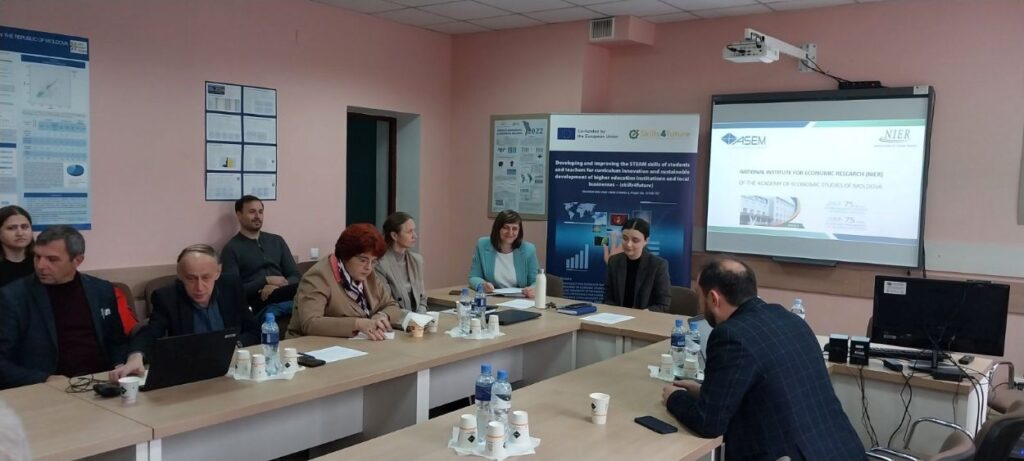
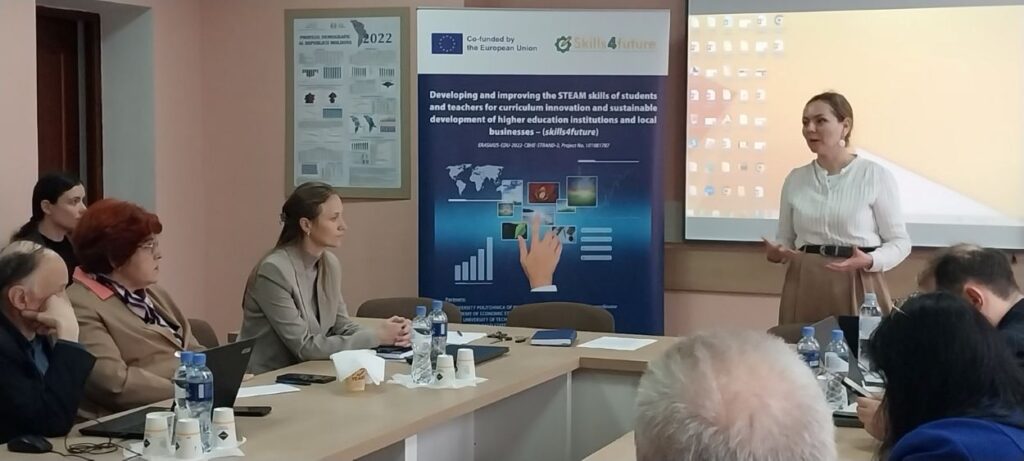
On November 27 – 28, 2025, the Agri-food economics and rural development department of NIER, AESM, organized the Exploitation workshop “Innovation and STEAM skills for sustainable growth of local private sectors” within the framework of the International ERASMUS+ Skills4future Project ”Developing and improving the STEAM skills of students and teachers for curriculum innovation and sustainable development of higher education institutions and local businesses”.
The event opened with a welcoming speech by Mrs. Mariana Buciuceanu-Vrabie, Scientific Secretary of the National Institute for Economic Research, who highlighted the importance of the project and presented the achievements of the INCE team within it. The invited project partners appreciated the implemented activities and emphasized the importance of developing STEAM competencies, which are essential for the sustainable growth of local private sectors.
During the event, experiences were shared by the National Farmers Federation of Moldova, the Agency for Intervention and Payments in Agriculture, the Association for the Promotion of Entrepreneurship, the National Horizon Europe Office, Sparkassenstiftung Moldova, the National Institute for Economic Research, the Cahul Business Incubator, and the Bălți branch of the Chamber of Commerce and Industry.
Taking into account the recent developments in the national economy and, in particular, in the agricultural sector, as well as the vulnerabilities it faces — including market fluctuations, technological changes, and competitiveness pressures — the discussions highlighted the strategic role of agriculture in the development of the Republic of Moldova. The need to strengthen this sector through effective support mechanisms was emphasized, especially through subsidies aimed at modernizing farms, adopting advanced technologies, and increasing productivity.
At the same time, the importance of Moldova’s involvement in international programs and projects, such as those funded under Horizon Europe, was underscored. These initiatives provide opportunities for research, innovation, technological development, and collaboration with European partners. They contribute not only to the modernization of agriculture but also to the integration of Moldova’s agricultural sector into European knowledge networks and best practices.
The event also included a visit to S.A. Franzeluța, where participants learned about the company’s production processes, successes, and the challenges it faces.
The event brought together students, practitioners, representatives of the business community, civil society, and public institutions.